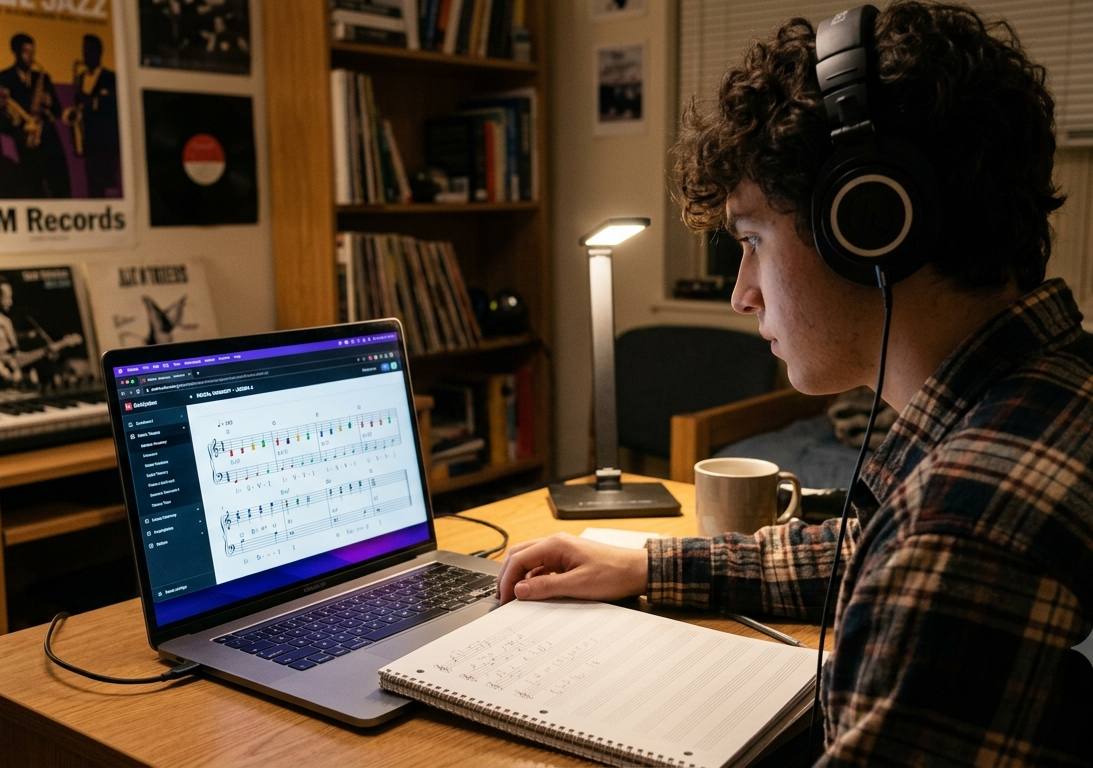
How to Learn Music Theory from Scratch (A Beginner's Guide to Chords, Scales & Harmony)
Music theory is often misunderstood as a dry, complex set of rules reserved for classical musicians. In reality, music theory is simply the language of music. It explains why certain notes sound great together and gives you the map you need to write songs, improvise freely, and learn new tracks in a fraction of the time.
Whether you play guitar, piano, drums, or sing, taking online music theory lessons will completely transform the way you interact with your instrument. Here is your ultimate beginner's guide to understanding the fundamentals.
1. The Building Blocks: Notes, Pitch, and Intervals
Before diving into complex chords, every musician needs to understand how sound is organized on the fretboard or keyboard:
- The Musical Alphabet: Music uses only 7 main letter names (A, B, C, D, E, F, G) plus sharps ($♯$) and flats ($♭$).
- Intervals: The distance between two pitch sounds. Understanding intervals is the secret to training your ear to recognize melodies instantly.
- Octaves: The distance between one note and the next note with the same letter name higher or lower.
2. The 3 Pillars of Applied Music Theory
Instead of memorizing abstract formulas, focus on applying theory directly to your instrument through three core concepts:
- Major & Minor Scales: Scales are the alphabet of melody. Mastering the Major and Natural Minor scales allows you to build chords and solo with confidence.
- Chord Progressions: Chords don't happen by accident. Understanding Roman Numeral notation (like I - V - vi - IV) helps you analyze and play thousands of popular songs easily.
- Ear Training: Connecting what you hear in your head to your fingers. Ear training helps you transcribe songs without needing sheet music or tabs.
Pro Tip: Never study theory in isolation. Every time you learn a new chord formula or scale pattern, immediately use it to compose a short rhythm or melody.
3. Why Learn Music Theory with a Maestro on Treeada?
Self-studying theory through random articles or videos can quickly feel overwhelming and disconnected from actual music-making.
A verified Maestro on Treeada will help you:
- Connect theoretical concepts directly to your specific instrument and favorite music genre.
- Break down complex ideas into digestible, practical exercises.
- Develop your ear and sight-reading skills at a comfortable pace.
Master the Language of Music on Treeada
At Treeada, we connect passionate students with world-class Maestros in music theory, composition, and performance. Learn at your own pace, from the comfort of home, with structured courses tailored to your goals.
Ready to understand music on a deeper level?
👉 Explore our Music Theory classes on Treeada and connect with your ideal Maestro today.
(Are you a Music Theory teacher? Join Treeada to share your knowledge, connect with global students, and monetize your expertise on a fair and secure platform).
Written by Treeada
View all courses and content from this creator.
More from Treeada

Como começar na Produção Musical e no Beatmakin...
Aug 29, 2026

How to Play Piano with Both Hands (A Beginner’s...
Aug 29, 2026

¿Cómo alcanzar notas agudas al cantar sin forza...
Aug 29, 2026